
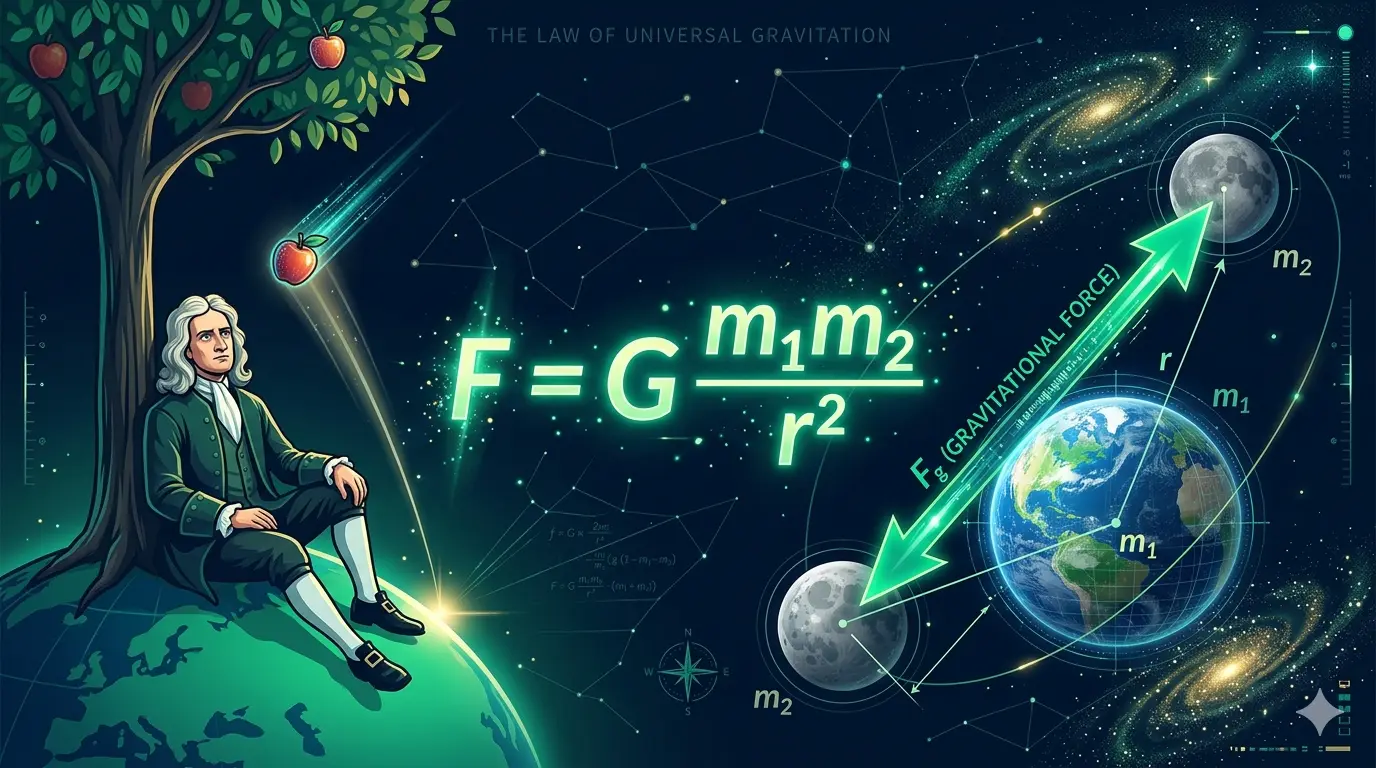
Newton’s Law of Gravitation: Formula, Derivation & Solved Problems
Understanding one of the fundamental forces of the universe
Gravity is the force that keeps our feet on the ground, holds the planets in orbit around the Sun, and governs the motion of galaxies. In 1687, Sir Isaac Newton revolutionized our understanding of the universe when he published his Law of Universal Gravitation in Principia Mathematica.
This blog post explains Newton’s Law of Gravitation in simple terms, perfect for high school and college students.
What is Newton’s Law of Universal Gravitation?
Newton proposed that every particle of matter in the universe attracts every other particle with a force that is:
- Directly proportional to the product of their masses
- Inversely proportional to the square of the distance between their centers
This force is known as gravitational force.
The Formula
The mathematical expression for Newton’s Law of Gravitation is:
$$ F = G \frac{m_1 m_2}{r^2} $$
Where:
- F = Gravitational force between two bodies (in Newtons)
- m₁ and m₂ = Masses of the two bodies (in kilograms)
- r = Distance between the centers of the two bodies (in meters)
- G = Universal Gravitational Constant = 6.67430 × 10⁻¹¹ N m² kg⁻²
G is a universal constant — its value remains the same throughout the universe.
Derivation of the Formula (Conceptual Approach)
Newton didn’t derive the formula purely mathematically from first principles. Instead, he combined several observations and mathematical insights:
- Kepler’s Laws: Newton studied planetary motion and realized planets move in elliptical orbits.
- Centripetal Force: For circular motion, a body needs a centripetal force directed toward the center.
- Inverse Square Law: From Kepler’s third law and his analysis, Newton concluded that gravitational force follows an inverse square relationship with distance.
Step-by-Step Reasoning:
- Gravitational force is proportional to the mass of the first body: F ∝ m₁
- Gravitational force is proportional to the mass of the second body: F ∝ m₂
- Gravitational force is inversely proportional to the square of distance: F ∝ 1/r²
Combining these proportions:
$$ F \propto \frac{m_1 m_2}{r^2} $$
To make it an equation, Newton introduced the constant G:
$$ F = G \frac{m_1 m_2}{r^2} $$
Key Characteristics of Gravitational Force
- It is always attractive (never repulsive).
- It is a long-range force (acts over infinite distances, though it becomes very weak).
- It is the weakest of the four fundamental forces.
- It obeys the Principle of Superposition (total force is the vector sum of individual forces).
Solved Problems
Problem 1: Basic Calculation
Question: Calculate the gravitational force between two 60 kg students standing 1 meter apart.
Solution:
$$ F = 6.6743 \times 10^{-11} \times \frac{60 \times 60}{1^2} = 2.403 \times 10^{-7} \text{ N} $$
This force is extremely small — about 0.00000024 Newtons!
Problem 2: Earth-Moon System
Question: Calculate the gravitational force between Earth (mass = 5.97 × 10²⁴ kg) and Moon (mass = 7.35 × 10²² kg) if the average distance is 3.84 × 10⁸ m.
Solution:
$$ F = 6.6743 \times 10^{-11} \times \frac{(5.97 \times 10^{24}) \times (7.35 \times 10^{22})}{(3.84 \times 10^8)^2} $$
$$ F \approx 1.98 \times 10^{20} \text{ N} $$
This enormous force keeps the Moon in orbit around Earth.
Problem 3: Acceleration Due to Gravity
Question: Derive the formula for acceleration due to gravity (g) on Earth’s surface.
Solution:
We know: $F = mg = G \frac{M m}{R^2}$
Where M = mass of Earth, R = radius of Earth.
Therefore:
$$ g = \frac{GM}{R^2} $$
Using G = 6.6743 × 10⁻¹¹, M = 5.97 × 10²⁴ kg, R = 6.37 × 10⁶ m, we get g ≈ 9.81 m/s².
Applications of Newton’s Law of Gravitation
- Calculating weights on different planets
- Orbital mechanics and satellite launches
- Tides in oceans
- Understanding black holes and galaxy formation
- Space exploration (trajectory calculations)
Limitations
While incredibly successful, Newton’s law fails at:
- Very high speeds (near speed of light)
- Extremely strong gravitational fields (Einstein’s General Relativity is more accurate)
Conclusion
Newton’s Law of Gravitation remains one of the most elegant and powerful laws in physics. It beautifully explains both everyday phenomena and cosmic events using a simple mathematical expression.
Key Takeaway: Gravity connects everything in the universe — from tiny atoms to massive galaxies.
Practice Question for Students:
Calculate the gravitational force between the Sun and Earth. (Mass of Sun = 1.99 × 10³⁰ kg, Mass of Earth = 5.97 × 10²⁴ kg, Distance = 1.496 × 10¹¹ m)
Happy Learning! Share this post with your classmates and teachers.
Related Topics to Explore:
- Kepler’s Laws of Planetary Motion
- Variation of g with altitude and depth
- Gravitational Potential Energy



Join the Conversation
0 Comments
Log in to join the discussion
No comments yet
Be the first to share your thoughts!