
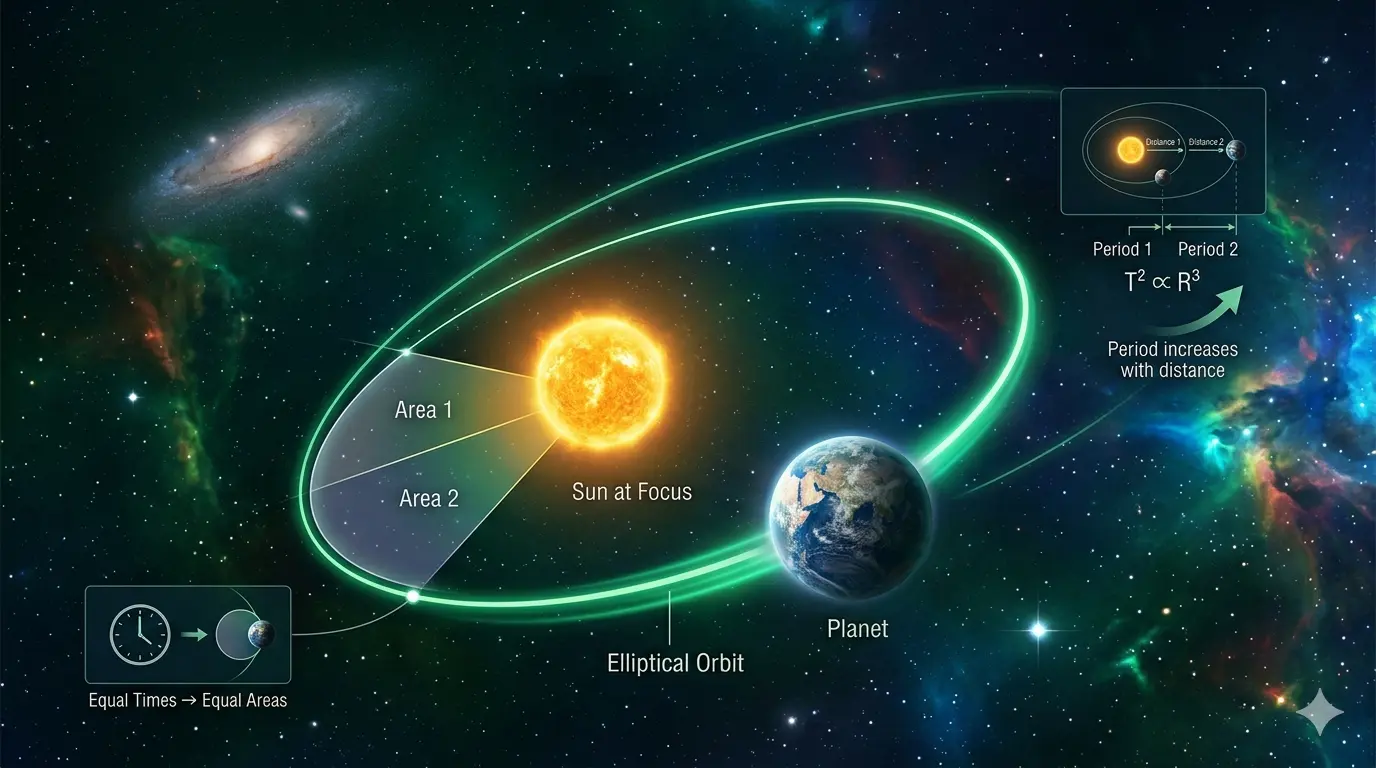
What Are Kepler's Laws of Planetary Motion?
Every GPS satellite, spacecraft, and exoplanet follows rules discovered by Johannes Kepler over 400 years ago — long before computers, telescopes, or even the discovery of gravity.
Kepler published his three laws between 1609 and 1619. They describe the shape, speed, and timing of orbits with remarkable accuracy. Today, they remain essential for space missions and discovering thousands of exoplanets.
Key Takeaways
- Planets orbit in ellipses, not perfect circles (First Law)
- They move faster when closer to their star (Second Law)
- Orbital period squared equals semi-major axis cubed: P² = a³ (Third Law)
- These laws power GPS, satellite orbits, and exoplanet detection
Who Was Johannes Kepler?
Johannes Kepler (1571–1630) was a German mathematician and astronomer. Using precise data from Tycho Brahe, he challenged the ancient belief that planets moved in perfect circles.
After years of calculations — especially trying to model Mars' orbit — Kepler discovered that planets follow ellipses. His work later helped Isaac Newton develop the law of gravity.
Kepler's First Law: Elliptical Orbits
Planets orbit the Sun in ellipses, with the Sun at one of the two foci.
An ellipse is like a stretched circle. The Sun sits off-center at one focus. The degree of stretch is called eccentricity (0 = perfect circle, closer to 1 = more elongated).
Earth’s orbit is nearly circular (eccentricity 0.017), but others vary. Mercury has the most elongated orbit among planets (0.206). This law applies to satellites, moons, comets, and exoplanets too.
Kepler's Second Law: Equal Areas in Equal Times
A line from a planet to its star sweeps out equal areas in equal times.
This means planets speed up when closer to their star (perihelion) and slow down when farther away (aphelion).
Why? Gravity pulls them faster as they fall inward, then they slow as they move outward. This is actually conservation of angular momentum.
Example: Earth moves at 30.3 km/s in January (closest to Sun) and 29.3 km/s in July.
Kepler's Third Law: The Harmony of Orbits
The square of a planet’s orbital period (P) is proportional to the cube of its average distance from the star (a).
P² ∝ a³
When using Earth years and Astronomical Units (AU), it becomes: P² = a³
Examples:
- Earth: 1 AU → 1 year
- Mars: 1.52 AU → 1.88 years
- Jupiter: 5.2 AU → 11.86 years
This law works for any star system, making it incredibly powerful for calculating exoplanet distances from their orbital periods.
Why These Laws Still Matter Today
Kepler’s laws are actively used in:
- GPS and satellites — predicting positions and designing orbits
- Space missions — planning efficient routes (Hohmann transfers)
- Exoplanet discovery — converting observed periods into orbital distances using the transit method
- Binary stars and black hole mass measurements
As of 2026, over 6,000 exoplanets have been confirmed using techniques built on Kepler’s work.
Limits of Kepler’s Laws
They work best for two-body systems. In complex systems with multiple planets, small corrections are needed. Einstein’s general relativity also explains tiny deviations (like Mercury’s perihelion precession).
Despite these limits, they remain the foundation of orbital mechanics.
Conclusion
Kepler’s laws replaced beautiful but wrong ideas (perfect circles) with a more accurate, elegant truth. From candlelit calculations in the 1600s to guiding modern spacecraft and discovering alien worlds, these three rules continue to shape our understanding of the universe.
They remind us that following the data — even when it challenges our assumptions — leads to real discovery.



Join the Conversation
0 Comments
Log in to join the discussion
No comments yet
Be the first to share your thoughts!