AI-Powered
TL;DR — Quick Summary
Click Generate Summary to get a quick AI-powered overview of this chapter.
Gemini is reading the chapter...
Could not generate summary. Please try again.
Explain This
Video Lessons
Triangle and Quadrilateral
Triangle: A triangle is a closed shape with three sides and three angles. The sum of its three angles is always 180 degrees.
Quadrilateral: A quadrilateral is a closed shape with four sides and four angles. The sum of its four angles is always 360 degrees.
Area of Triangle and Quadrilateral
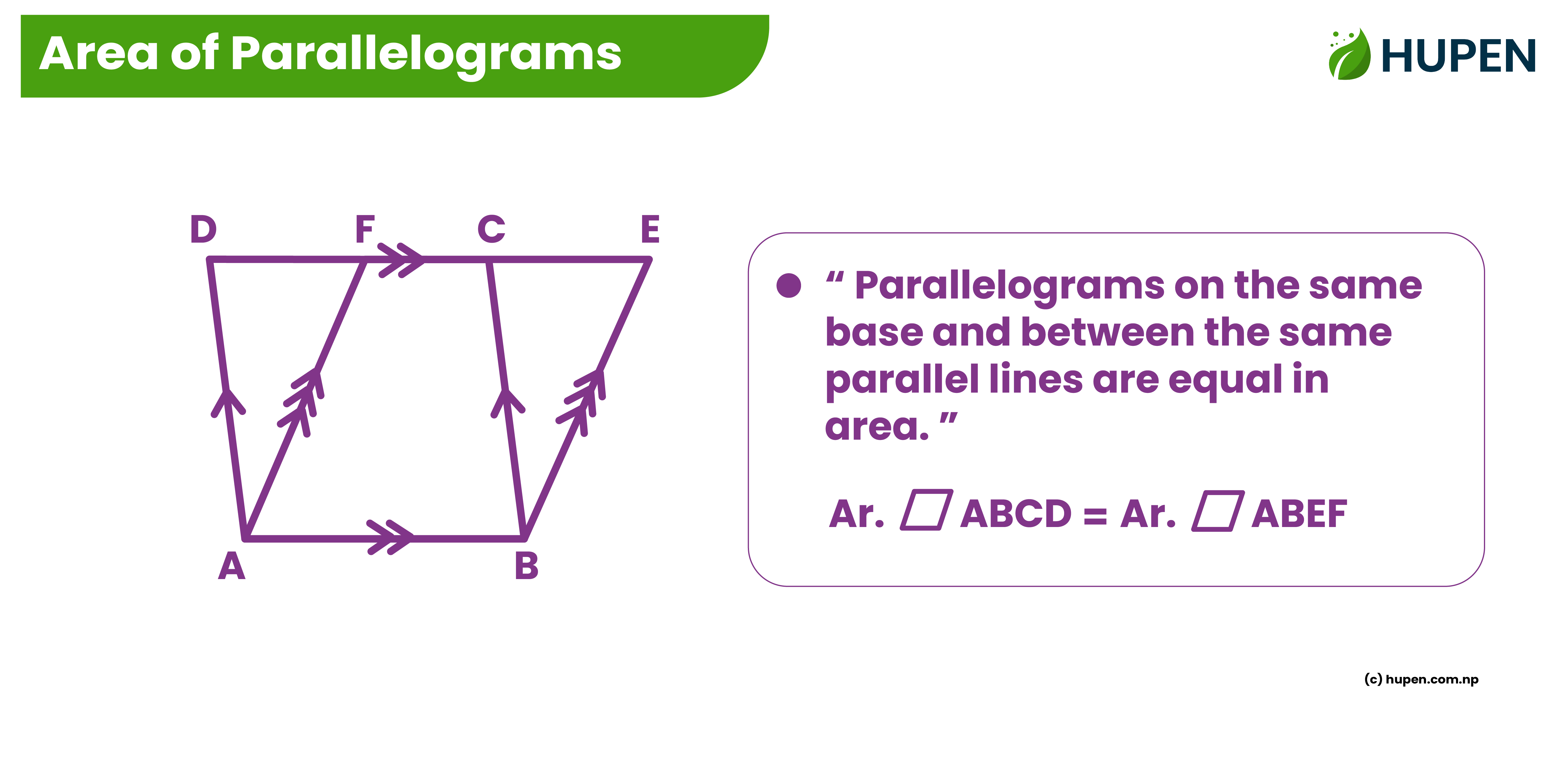
Theorem 1: Parallelograms on the same base and between the same parallel lines are equal in area.
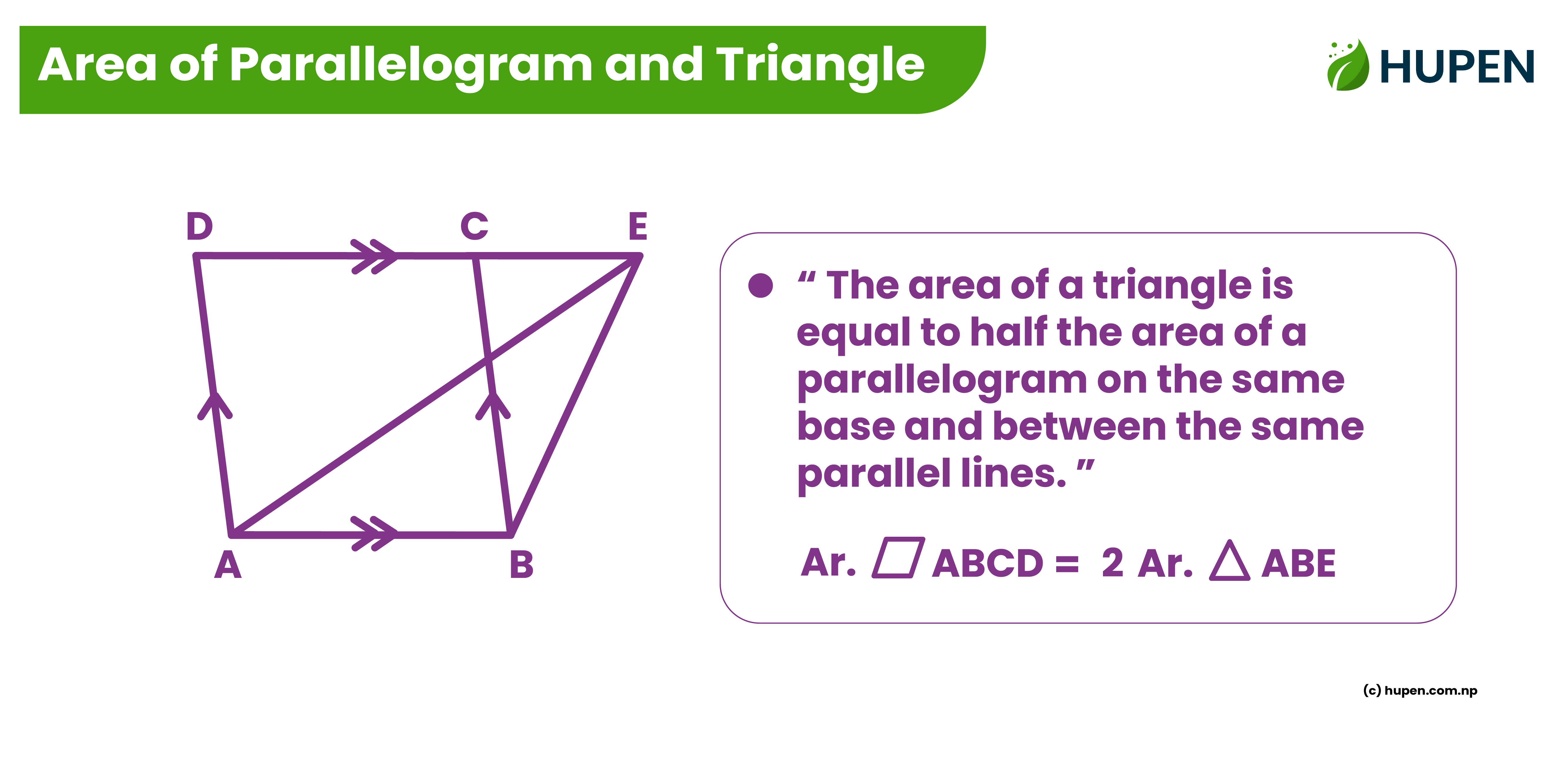
Theorem 2: The area of a triangle is equal to half the area of a parallelogram on the same base and between the same parallel lines.
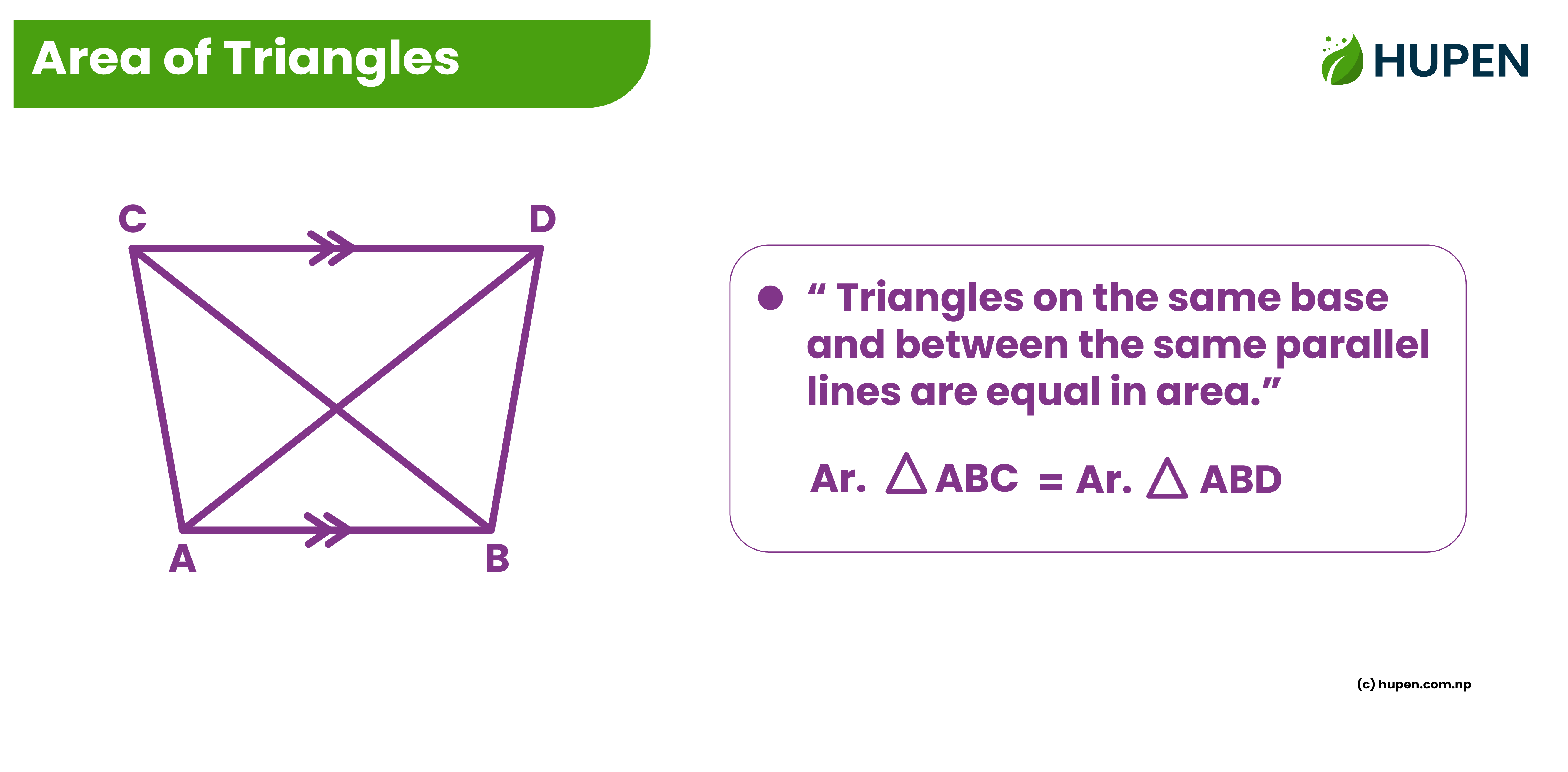
Theorem 3: Triangles on the same base and between the same parallel lines are equal in area.
Practice Exercises
Reinforce your learning! Attempt these exercises to
build deep mastery and prepare for your quizzes.
Q1.
In a figure, parallelograms FGHE and FGIJ are standing on the same base FG, where, FE || GH, EI || FG and FJ || GI. [SEE 2080 SP]
-
a.
Are the area of parallelograms FGHE and FGIJ same? [1K]
-
b.
Prove that: Area of \(\triangle EFJ\) = Area of \(\triangle HGI\). [2U]
-
c.
When the parallelogram EFGH is made as a rectangle lying on the same base FG, will it make any change in the area? Write with reason. [1HA]