
Introduction
Ammonia (NH₃) is a colorless gas with a characteristic pungent smell. It is one of the most important industrial chemicals and serves as a precursor for fertilizers, explosives, and various organic compounds. In the laboratory, ammonia gas is commonly prepared for qualitative analysis, studying its properties, or demonstrating basic gas preparation techniques.
The laboratory method is safe, simple, and uses readily available reagents.
Principle
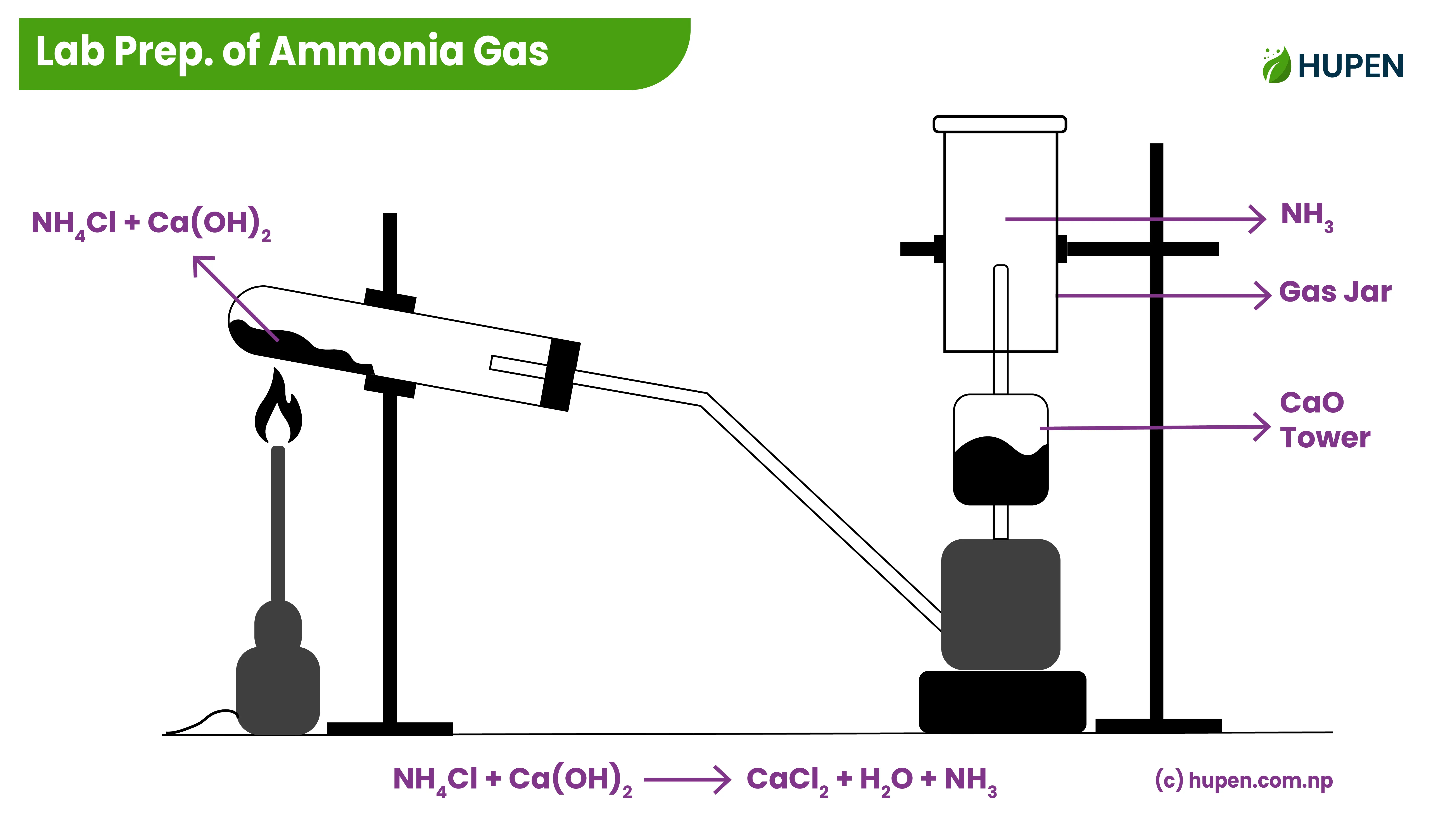
Ammonia gas is prepared by heating an ammonium salt (usually ammonium chloride) with a strong base (calcium hydroxide or slaked lime).
Chemical Reaction:
This is a displacement reaction where the stronger base (calcium hydroxide) displaces the weaker base (ammonia) from its salt.
Materials Required
Chemicals:
- Ammonium chloride (NH₄Cl) — 10–15 g
- Calcium hydroxide (Ca(OH)₂) — 15–20 g (freshly prepared or dry slaked lime)
Apparatus:
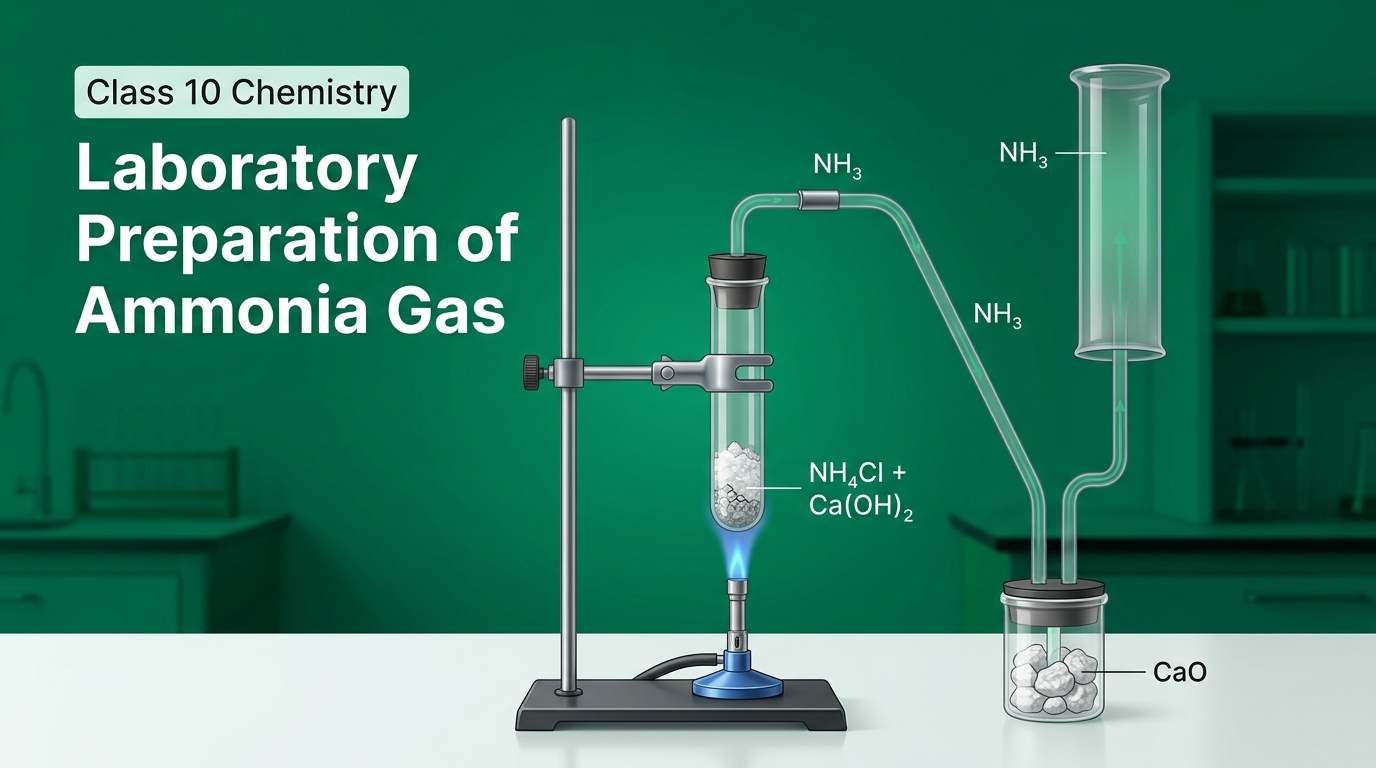
- Hard glass test tube or round-bottom flask
- Delivery tube
- Cork with two holes (if using flask)
- Gas jar or test tubes for collection
- Stand and clamp
- Bunsen burner or spirit lamp
- Calcium oxide (quicklime) or soda lime (for drying, optional)
- Litmus paper (for testing)
Step-by-Step Procedure
Preparation of Mixture
Mix ammonium chloride and calcium hydroxide thoroughly in a 1:1.5 ratio (by weight) in a mortar. The mixture should be dry and finely powdered.
Setup the Apparatus
Place the mixture in a hard glass test tube or round-bottom flask. Fit it with a delivery tube. The delivery tube should be slanted downward because ammonia is lighter than air.
Heating
Heat the mixture gently at first, then strongly. Ammonia gas starts evolving.
Collection
Collect the gas by downward displacement of air (since NH₃ is lighter than air and highly soluble in water).
- Invert a dry gas jar over the delivery tube.
- When the jar is full (test with moist red litmus paper — it turns blue), cover it with a glass plate.
Drying (Optional)
If dry ammonia is required, pass the gas through a tower containing quicklime (CaO) or soda lime. Do not use concentrated H₂SO₄ or CaCl₂ as they react with ammonia.
Confirmation Tests
- Smell: Characteristic pungent, choking smell.
- Litmus Test: Moist red litmus turns blue.
- HCl Test: Dense white fumes with concentrated HCl (forms NH₄Cl). $$ NH_3 + HCl \rightarrow NH_4Cl \ (white\ smoke) $$
- Copper Sulfate Test: Turns deep blue solution with CuSO₄.
Precautions
- Perform the experiment in a well-ventilated fume hood. Ammonia is irritating to eyes, nose, and respiratory system.
- Do not inhale the gas directly.
- Use dry apparatus because ammonia is extremely soluble in water.
- Heat gently to avoid cracking the glass tube.
- Dispose of the residue (calcium chloride) properly.
- Never use sodium hydroxide or potassium hydroxide in place of Ca(OH)₂ for this preparation as they produce water and make the setup messy.
Properties of Ammonia (Quick Revision)
| Property | Description |
|---|---|
| Density | Lighter than air (0.77 g/L) |
| Solubility in water | Extremely high (forms NH₄OH) |
| Nature | Basic |
| Boiling Point | -33.34°C |
| Uses | Fertilizers, refrigeration, cleaning |
Why This Method?
This method is preferred in labs because:
- Reagents are cheap and easily available.
- Reaction occurs at moderate temperature.
- No expensive catalysts are needed.
- High yield of gas.
Conclusion
The laboratory preparation of ammonia gas is a classic experiment that beautifully demonstrates acid-base chemistry and gas collection techniques. Understanding this process helps students grasp concepts like solubility, density of gases, and basic laboratory safety.
Pro Tip: Always dry the gas if you're planning to study its reaction with dry reagents (like metals or halogens).
Join the Conversation
0 Comments
Log in to join the discussion
No comments yet
Be the first to share your thoughts!