
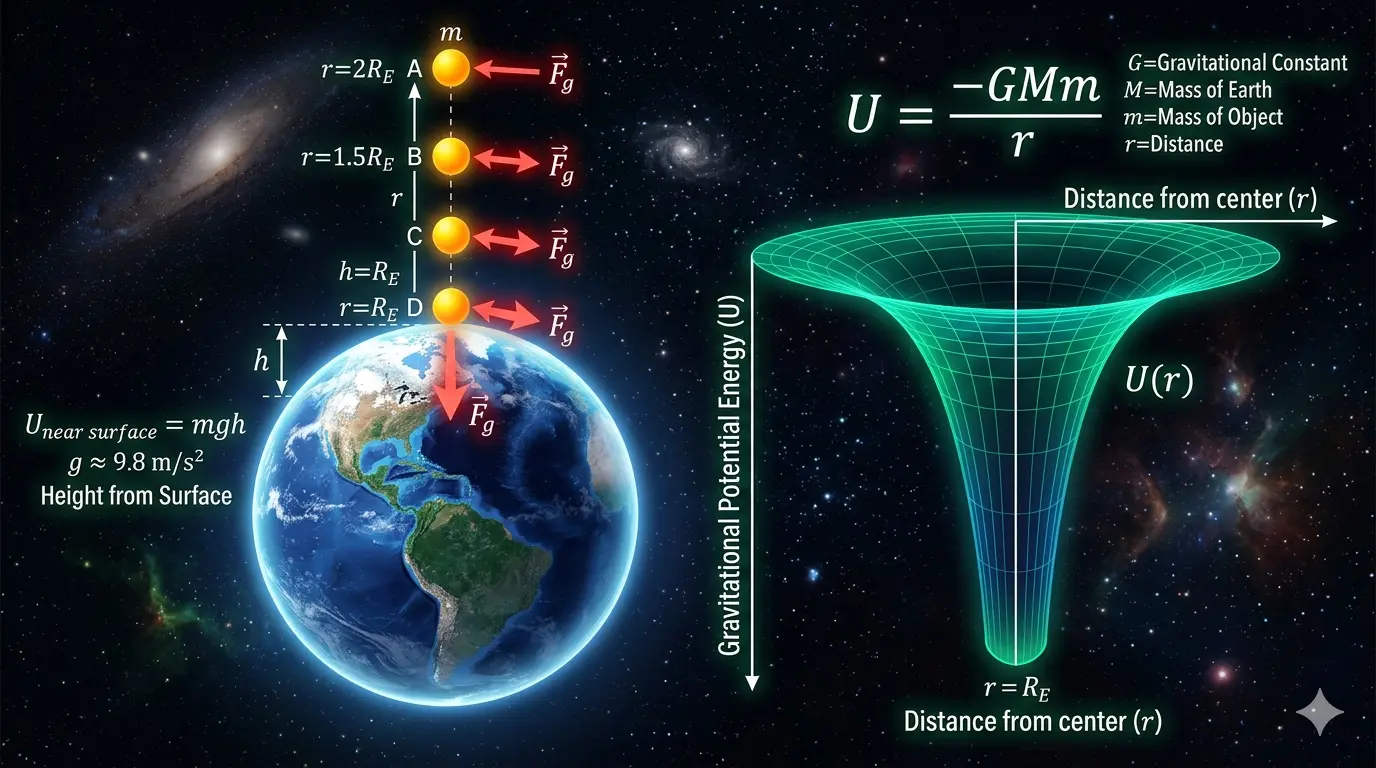
What is Gravitational Potential Energy?
Potential energy is the energy stored in an object due to its position or configuration in a force field. Gravitational potential energy (often denoted as U or PE) specifically arises from an object's position in a gravitational field.
There are two common forms:
- The simplified version near Earth's surface: U = mgh
- The general form for any two masses: U = -GMm/r
We'll derive both.
Step 1: The Near-Earth Approximation (U = mgh)
When objects are close to Earth's surface (compared to Earth's radius), the gravitational field is nearly uniform. We can treat the acceleration due to gravity g as constant (≈ 9.8 m/s² downward).
Derivation from Work-Energy Principle
The gravitational force on a mass m is F = mg (downward).
Work done by gravity when an object moves vertically from height h₁ to h₂ (where h₂ < h₁) is:
$ W_\text{gravity} = \vec{F} \cdot \vec{d} = mg \cdot (h_1 - h_2) $
Since gravity is a conservative force, the change in potential energy is defined as:
$ \Delta U = -W_\text{conservative} $
Therefore:
$ U(h_2) - U(h_1) = -mg(h_1 - h_2) $
$ U(h_2) = U(h_1) - mg(h_1 - h_2) $
If we choose the reference point U = 0 at h = 0 (ground level), then:
$ U(h) = mgh $
This is the familiar formula. It's an approximation valid when h << R_Earth (Earth's radius ≈ 6371 km), so the variation in gravitational force is negligible.
Step 2: The General Derivation (U = -GMm/r)
For points far from a planet or between any two masses, we cannot assume constant g. We must use Newton's Law of Universal Gravitation.
The gravitational force between two masses M (e.g., Earth) and m separated by distance r is:
$ F(r) = -\frac{GMm}{r^2}$
$\text{(negative sign indicates attraction)} $
Deriving Potential Energy from the Force
For any conservative force, the potential energy difference between two points is:
$ U(r) - U(r_\text{ref}) = -\int_{r_\text{ref}}^{r} \vec{F} \cdot d\vec{r} $
The most natural reference point for gravity is infinity (where the force becomes zero), so we set U(∞) = 0.
$ U(r) = -\int_{\infty}^{r} F(r), dr = -\int_{\infty}^{r} \left(-\frac{GMm}{r^2}\right) dr $
$ U(r) = GMm \int_{\infty}^{r} \frac{1}{r^2}, dr $
$ U(r) = GMm \left[ -\frac{1}{r} \right]_{\infty}^{r} $
$ U(r) = GMm \left( -\frac{1}{r} - \lim_{r \to \infty} \left(-\frac{1}{r}\right) \right)$
$ \therefore U(r) = -\frac{GMm}{r} $
Final Result:
$ \boxed{U(r) = -\dfrac{GMm}{r}} $
The negative sign is important:
- It means gravitational potential energy is always negative for bound systems.
- At infinite separation, energy is zero (the maximum).
- Closer objects have lower (more negative) potential energy.
Why is the Negative Sign Crucial?
To escape Earth's gravity completely (reach infinity), an object needs enough kinetic energy to overcome the negative potential energy:
Escape velocity from Earth's surface:
$ \frac{1}{2}mv^2 = \frac{GMm}{R_E} \implies v = \sqrt{\frac{2GM}{R_E}} \approx 11.2 \text{ km/s} $
Connecting the Two Formulas
Near Earth's surface, let r = R_E + h where h is small.
$ U(r) = -\frac{GMm}{R_E + h} $
Using binomial approximation:
$ U(h) \approx -\frac{GMm}{R_E} \left(1 - \frac{h}{R_E}\right) = -\frac{GMm}{R_E} + \frac{GMm}{R_E^2}h $
The constant term -GMm/R_E can be ignored if we only care about changes in energy. The varying part becomes:
$ \Delta U \approx m \left(\frac{GM}{R_E^2}\right) h = mgh $
where g = GM/R_E².
Real-World Applications
- Hydroelectric power: Water at height has high gravitational PE → converted to kinetic energy → electricity.
- Satellites and orbits: Total mechanical energy E = K + U determines if an orbit is bound (elliptical) or unbound (hyperbolic).
- Black holes: Extremely deep gravitational potential wells.
- Space travel: Calculating delta-v requirements for missions.
Common Misconceptions
- "Potential energy is stored in the object" — Actually, it's stored in the gravitational field (or the system of two masses).
- Higher means more energy — True near Earth, but in the general case, closer to the mass means lower (more negative) potential energy.
- g is always constant — Only a good approximation near the surface.
Summary
- Near surface: U = mgh (reference at ground)
- General case: U = -GMm/r (reference at infinity)
The general form emerges naturally from integrating the inverse-square gravitational force, showing the deep connection between force and potential in physics.



Join the Conversation
0 Comments
Log in to join the discussion
No comments yet
Be the first to share your thoughts!