
Introduction
Calculus is one of the most powerful branches of mathematics used in science, engineering, economics, and technology. One of the most important concepts in calculus is the derivative.
The derivative helps us understand how a quantity changes over time or with respect to another variable. It is used to measure things like speed, growth, slopes of curves, and optimization problems.
In this article, you will learn:
- What a derivative in calculus is
- The derivative formula
- The geometric meaning of derivatives
- Basic derivative rules
- Solved examples
- Real-life applications of derivatives
If you are new to calculus, this guide will help you understand derivatives in a simple and beginner-friendly way.
What is a Derivative in Calculus?
A derivative measures how a function changes when its input changes.
In simple words: A derivative tells us the rate of change of a function.
For example, suppose a car is moving along a road. The car's position changes over time. The rate at which the position changes is called the velocity. In calculus, velocity is actually the derivative of position with respect to time.
If a function is written as \(y = f(x)\)
then the derivative of the function is written as \(f'(x)\) or \(\frac{dy}{dx}\).
Both notations represent the derivative of y with respect to x.
Understanding Derivatives with a Simple Idea
To understand derivatives better, imagine the following situation.
Suppose the distance traveled by a car is given by the function
\(s(t) = t^2\) where t represents time.
If we want to know how fast the car is moving at a particular moment, we calculate the derivative of the distance function.
The derivative gives the instantaneous rate of change, which means the speed of the car at that exact moment.
A Brief History of Derivatives
Derivatives were co-invented in the 17th century by Isaac Newton and Gottfried Wilhelm Leibniz. Newton used them for physics (like planetary motion), while Leibniz focused on the notation we still use today, like \(\frac{dy}{dx}\).
In short, a derivative turns a function into another function that describes its rate of change. Now, let's learn how to compute them without always relying on the limit definition.
Geometric Meaning of a Derivative
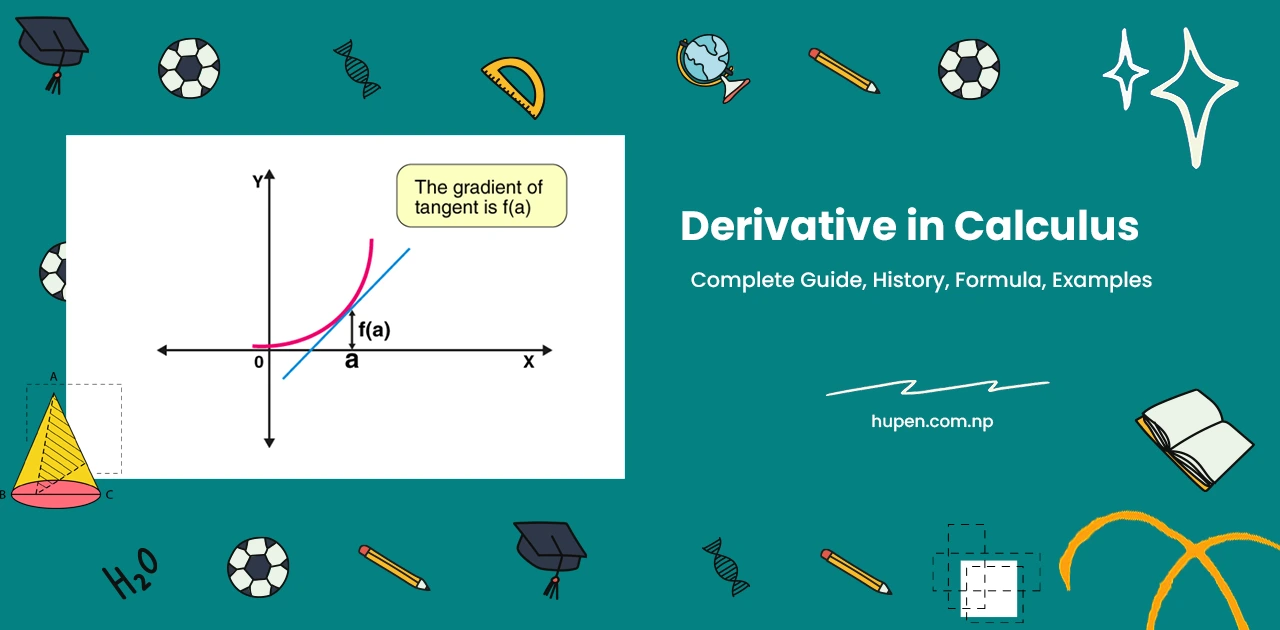
In geometry, a derivative represents the slope of the tangent line to a curve at a specific point.
Imagine a curve drawn on a graph.
- A tangent line touches the curve at exactly one point.
- The slope of this tangent line represents the derivative of the function at that point.
This means the derivative tells us **how steep the curve is at a particular point**.
If the slope is:
- Positive → the function is increasing
- Negative → the function is decreasing
- Zero → the function has a maximum or minimum point
Derivative Formula (Limit Definition)
The derivative of a function is formally defined using **limits**.
The definition of the derivative is:
This formula is called the first principle of derivatives.
What does this formula mean?
- (h) represents a very small change in (x)
- The formula measures how much the function changes when (x) changes slightly
- When (h) approaches zero, we get the instantaneous rate of change
Although this formula may look complicated at first, it forms the foundation of differential calculus.
Basic Derivative Rules
Instead of always using the limit definition, mathematicians developed rules that make derivatives easier to calculate.
Here are some of the most important derivative rules.
1. Power Rule
The power rule is one of the most commonly used derivative rules.
2. Constant Rule
The derivative of a constant number is always zero.
3. Constant Multiple Rule
If a constant multiplies a function, the derivative is the constant times the derivative of the function.
4. Sum Rule
The derivative of the sum of two functions is the sum of their derivatives.
Solved Examples of Derivatives
Let's look at some simple examples to understand derivatives better.
Example 1 : Find the derivative of \(f(x) = x^2\)
Solution:
Using the power rule.
\(\frac{d}{dx}(x^2) = 2x\)
So, \(f'(x) = 2x\)
Example 2 : Find the derivative of \(f(x) = 4x^3\)
Solution
\(\frac{d}{dx}(4x^3) = 4 \times 3x^2\)
\(= 12x^2\)
Example 3 : Find the derivative of \(f(x) = 3x^2 + 5x + 7\)
Solution:
Derivative of (3x^2) = (6x), Derivative of (5x) = (5), Derivative of (7) = (0)
Final answer: \(f'(x) = 6x + 5\)
Real-Life Applications of Derivatives
Derivatives are not just theoretical mathematics. They are used in many real-world situations.
1. Physics : In physics, derivatives are used to calculate:
- velocity
- acceleration
- motion of objects
For example: Velocity is the derivative of position with respect to time.
2. Engineering : Engineers use derivatives for:
- structural design
- system optimization
- signal processing
Derivatives help determine how systems behave when variables change.
3. Economics : In economics, derivatives help analyze:
- cost functions
- profit maximization
- marginal revenue
Businesses use derivatives to determine the best production levels.
4. Machine Learning and AI : Derivatives play an important role in machine learning algorithms.
Many algorithms use derivatives to minimize errors using techniques such as gradient descent.
Why Are Derivatives Important?
Derivatives are extremely important because they help us:
- analyze changing quantities
- find maximum and minimum values
- understand graphs and curves
- solve optimization problems
- model real-world situations
Without derivatives, modern science, engineering, and technology would not be possible.
Summary
A derivative in calculus measures how a function changes with respect to its variable.
Key points to remember:
- A derivative represents the rate of change of a function
- It gives the slope of the tangent line to a curve
- It is defined using limits
- Several rules make derivative calculations easier
- Derivatives have many applications in science, engineering, and economics
Understanding derivatives is one of the first major steps in learning calculus, and it forms the foundation for more advanced topics such as integration, differential equations, and optimization.
Practice Questions
Try solving these derivative problems.
1. Find the derivative of \(f(x) = x^3\)
2. Find the derivative of \(f(x) = 6x^2 + 4x\)
3. Find the derivative of \(f(x) = 9\)
4. Find the derivative of \(f(x) = 2x^4\)
Frequently Asked Questions (FAQ)
Q.1 : What is a derivative in simple terms?
A derivative measures how fast a function changes with respect to its variable.
Q.2: What does the derivative represent graphically?
Graphically, a derivative represents the slope of the tangent line to a curve at a specific point.
Q.3: What are common symbols for derivatives?
Common derivative notations include:
- \(f'(x)\)
- \(\frac{dy}{dx}\)
Q.4 : Why are derivatives useful?
Derivatives help analyze change, find maximum and minimum values, and solve real-world problems in science, engineering, and economics.
Join the Conversation
0 Comments
Log in to join the discussion
No comments yet
Be the first to share your thoughts!